Facebook

Lots of Iron at Bayfield Cottage

The Road Name Says It All!

 
One look at the road sign and you just know that the water won’t be crystal clear coming up from the well.

When there’s iron in the water, the rust causes all kinds of problems. The sinks, showers and toilets all turn a lovely shade of brown. The fixtures start to drip because they won’t close properly and, maybe the worst of all – anything white that goes into the washing machine comes out covered in orange-coloured blotches.

The east shore of Lake Huron is known for its beautiful cottages. Over the years, we have installed a lot of iron filters and water softeners up and down the coast – from Grand Bend to Bayfield to Goderich and even up into the Kincardine area.

Seasonal cottages present a unique challenge – they’re frozen solid in the winter! Reverse osmosis drinking systems, iron filters and water softeners can’t handle temperatures below zero – freezing can seriously damage these units.

Some folks drain the water out and dump plumbing anti-freeze into these systems, but that’s not a good idea either. The ethylene glycol can damage the softening resin and, it only takes a little bit of water sitting up in the control valve to freeze and split the plastic body wide open.
 

Installed in the Spring & Removed for the Winter

One of the services we offer is winter storage. When the nice weather rolls around, we bring the units to your cottage and hook them up. After you’ve enjoyed the summer with friends and family, arrangements are made and we will return in the autumn to take the systems back to our heated shop.


Pure water for operating room & laboratory

Alexandra Marine & General Hospital in Goderich

 
At pre-scheduled service intervals, the water treatment equipment at the Goderich Hospital (Huron County) is maintained to ensure that the water quality is the very best it can be. Water tests are conducted and each piece of equipment is cared for as per rigid operating procedures.

Chlorine Removal

The pure water used in the operating room area and the laboratory first passes through a backwashable carbon filter to completely remove the chlorine. The chlorine was added by the town of Goderich at the water treatment plant to kill any bacteria that might be present in the source water. Now that it has done its job while in the towns distribution system, it needs to be removed. By passing through a very high quality grade of carbon, the chlorine is removed.

Reverse Osmosis

The next step in the water treatment is to purify it using a commerical grade reverse osmosis system. This removes 99.9% of all dissolved contaminants from the water, filling a large resevoir with enough pure water to allow each area of the hospital to use as much as they need without having anyone run short. The filters are changed and the system regularly flushed with a sanitizing solution.

Ultra Violet Light

The third step in the process is to recirculate the water through a de-ionization system and an ultra violet light. The light acts as a backup system yet is always on to kill any living organism that might inadvertently enter the system (extremely unlikely given the previous steps taken to ensure safety and quality).

At this point, the water quality is such that it can be used by the staff in the operating room area and the laboratory.

During the service visits, we also sanitize the reservoir and each faucet where the clean water is used. The staff at the hospital know us quite well and have given us permission to move about between the different departments as needed.

In addition to the super pure water system just mentioned, there is also a water softener that removes the hardness and supplies soft water to specific parts of the building.


Pharmasave in Bayfield has reverse osmosis

Staff room has purified drinking water

It only makes sense – if you have a medical centre that cares for people’s health and a pharmacy that provides excellent service with free consultations – shouldn’t the staff be drinking good, pure water? Owners Michael & Nevien Ibrahim thought so.

The water being supplied to this new building on Main Street in Bayfield (between Goderich and Zurich) comes from a deep well. Although the water is reasonably clean and isn’t presenting any immediate issues, they felt that having filtered water for the staff to make coffee & tea with was important. As well, the reverse osmosis faucet mounted at the sink is convenient for filling water bottles.

(On a side note, the Ibrahim’s also had us install one at their house – along with a high effeciency water softener to eliminate the problem of cloudy looking dishes and rust stains in the showers and sinks.)

On an annual basis, we test the water quality, change the filters and flush the system out.


How often should I clean out the salt tank?

Problems with salt bridging or clumping together

On alot of the water softener service calls we go on, once we have tested the water and examined the unit, it’s often determined that the primary cause of the problems has to do with the salt.
 

Bridging

The top left picture is a classic example of a salt bridge. The water softener has gone through numerous cleaning cycles and dissolved ALL the salt in the bottom half of the brine tank – leaving a ‘bridge’ of super hard salt above the water line. When the softener goes into the ‘brine draw’ part of the regeneration cycle, instead of sucking in a strong solution of sodium chloride, all it gets is straight water.

Using a large slotted screwdriver (and a fair amount of physical work), the bridge has to be broken apart until it collapses into the water below.
 

Clumping

Another common problem is when the salt clumps together into a mushy, gooey mess. The middle picture above shows how some brands of evaporated salt can create big problems. When the clumping gets really bad, the water level in the brine tank will gradually rise and eventually overflow – either around the lid or out the ‘overflow port’ on the side. The salty water gets all over the floor and evaporates, leaving the salt behind. The salt that comes in the wavy chunks seems to have the most problems with clumping together.


What we suggest

Every 5 years, thoroughly clean out the brine tank. This can be a bit of a messy job so be sure to have lots of old towels (and maybe a mop) readily available. You’ll also need some buckets and something to scoop with.

Start by scooping out any water that is in the tank. Once you’re down to the salt, scoop out as much of it as you can as well.Your goal is to make the brine tank as light as possible because the next step is to disconnect it from the softener control valve and carry it outside. Once you’ve located a place where you don’t mind washing away the remaining salt, use the garden hose to completely wash out the inside of the tank.

Be sure to blast some water down the brine well where the brine wand is located. The one area you need to ensure is completely free of any residual salt is at the bottom of the brine well. Depending on your model, there will either be a series of slits cut into the plastic tube or there will be a platform with a series of small holes in it. Either way, be sure to wash away all the remaining salt.

Take the brine tank back indoors and reattach to the control valve. Dump in a few bags of clean, new salt and then pour in enough clean, fresh water to fill the tank up to about 1/4 - 1/3 full. Manually start the water softener into a regeneration cycle. When the cleaning cycle is done, the cold water will be conditioned again and completely soft. Depending on the size of your hot water tank and the size of your family, the hot water will be completely soft again in a few days.

If problems still exist after you’ve cleaned out the brine tank, the water softener might need some additional service.


To avoid having problems again in the future, get in the habit of letting the salt run low in between fill ups. Instead of always keeping the salt tank more than 1/2 full, let it run down until there is only 6″ of salt left in the bottom. At that point, add enough bags of salt to bring it back up near the top. By doing this, we’ve found that our customers have a lot less problems with bridging and clumping.


Ridgewood Subdivision North of Goderich

Extremely hard water with lots of iron


If you live north of Goderich in Huron County then you already know how hard the water is. In addition to the very high level of calcium which leaves white residue on all the dishes and fixtures, the area is also home to some nasty iron.

New homeowners contacted us to come out and test the water. They had just moved into their beautiful new home and – within a few weeks – started noticing that all the toilets were turning a rusty orange colour.

As can be seen in the above picture (the 2 sets of tubes running vertical in the top right corner), the entire house has been plumbed with clear ‘pex’ pipe. These lines, both hot and cold, were turning a dark orange colour from the iron starting to build up in them. If left untreated, raw water like this can cause all kinds of problems including;


→ Dishes coming out of the dishwasher with food still on them and the glassware looking ‘streaky’

→ Laundry feeling scratchy with the colours looking duller after each wash

→ Harsh cleaners and chemicals needed to get the fixtures, tubs and showers looking clean

→ An increase of approximately 15% in either electricity, gas or oil to heat the water in the water heater

→ A shortened life expectancy for both your dishwasher and washing machine (as per authorized appliance repairmen)

 
For this customer, and many others around Bayfield, Goderich and Clinton, the best solution was to install a water softener with an internal attachment that removes the iron. The free water test gave us the information needed to select the best make & model for the situation.

Once the water coming into the house was conditioned, the family wanted purified water for drinking and cooking. A reverse osmosis system was installed with a large holding reservoir for the pure water. Instead of a little pressure tank pushing the filtered water up to each faucet, we installed an electric delivery pump to ensure super fast flow and consistent pressure.

With most reverse osmosis drinking systems, the water just trickles out of the faucet and it takes a few minutes to fill a large container or pot. With this setup, it only takes a few seconds to get litres of water!


Broiler Barns Have Treated Water

Operation in Huron County near Lucknow


One of the biggest problems facing chicken producers in Huron County when it comes to their water is excess iron building up in the equipment and plugging the drinker systems. There are numerous water treatment methods available depending on the severity of the problem, the flow rates, the number of birds and the budget available.


For this customer, he had a unique solution for figuring out where to have the iron removal system installed. The utility room for the barn was already filled with 2 big pressure tanks, the distribution manifold for the water lines and a small bathroom so he welded up a heavy-duty shelf above the wash-up station.

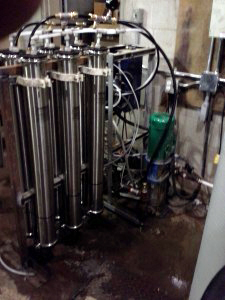
This shelf holds the backwashable filter, a contact tank, a recirculation pump, an oxygen concentrator and an ozone generator. The system has been in place for a number of years now and has performed excellent with only minor service periodically.


Each component was selected based on its history of performance. In order to be considered for this application, it had to be extremely reliable and be able to be serviced quickly if needed.

On an annual basis, the customer is contacted to arrange an on-site water test and inspection.


Central Huron Arena Upgrade

Commercial Water Softener For Clinton Arena

 
The new arena is done and comes complete with a skating rink, walking track, kid’s play zone, meeting rooms and a fully equipped YMCA that shares its membership privileges with the Goderich facility.

As with any new commercial building, there is a boiler system, water heaters, a dishwasher and hundreds of feet of pipe to consider when suppling water into the facility. There are also lots of faucets, sinks and toilets that could be damaged by hard water if the issue had been left unaddressed.

After consulting with the maintenance staff on the best way to remove all the calcium (hardness) and soften the water, it was decided that a single tank water softener loaded with very high grade resin should be installed.

The Magnum control valve can handle over 60 gallons per minute if needed, and there is enough capacity to ensure that even if there is an abnormally high amount of water used on any given day – it will be perfectly conditioned.


Economy Water Softener

Well Water Near Blyth

 
Sometimes all you’re looking for is a small system that can condition the water for 2 people. The raw water test at the property where this water softener was installed (between Clinton and Wingham in Huron County) showed a moderate level of hardness and a trace amount of iron.

If there was a large family living at the house, this small unit would not be able to handle the demand. However, this model was perfect for the situation and we were able to install it within a couple of days of them calling our shop.

The first thing you notice is that the salt tank is blue, the control valve is black and the mineral tank that holds the softening resin is a natural coloured fibreglass. That’s what you call mis-matched. Sometimes the distributors want to clear out some of their inventory and they offer it to us at fantastic savings if we aren’t picky about the shapes, colours and sizes.

The discounts get passed onto you. After an in-home water test to determine how much calcium (hardness), iron (rust) and sulphur there is, we can give you a quote on what we have available.